
A speaker one sheet is a single page that lets a planner sell you to people you will never speak to. It gets forwarded and skimmed for about forty seconds, and that skim either moves you to a shortlist or ends the conversation.
That is the whole design brief. Everything below follows from it.
What belongs on the page
- One strong on-stage photo: you, in front of an audience, mid-talk.
- A headline about the audience, not your title. What the room leaves able to do.
- A 75 to 100 word bio leading with what you built.
- Two to four titled talks with a sentence each on the takeaway.
- Proof: client logos and one short testimonial from a named client.
- Fees by location (local, domestic, international, virtual), labelled gross or net, with a line on travel.
- Booking contact, in a place someone can find in two seconds.
The headline is the part most people get wrong
"Keynote Speaker and Author" describes you. It gives a planner nothing to argue for in a meeting.
A headline earns its place by naming the change in the room: what the audience believes or does differently afterwards. Planners are not buying a speaker, they are buying an outcome they have to defend to a budget holder.
What gets a one sheet quietly declined
Three things account for most of it. A photo taken at a desk rather than on a stage, because it signals you have not spoken much. Talk titles with no takeaway, which make the planner do your work. And no visible fee band or contact route, which turns a quick forward into an errand.
None of those are about quality. They are about friction, and friction is what kills a forward.
What a bureau does with your one sheet
We attach it to an email with two other speakers' one sheets and send it to a client who asked for options. It is compared side by side, at speed.
The one sheet that wins is rarely the most designed. It is the one where a planner can answer "why this person for our room" without opening anything else. If you want the wider context, our guide on how to become a keynote speaker covers where the one sheet sits in the full package.
A worked example: what a planner reads in forty seconds
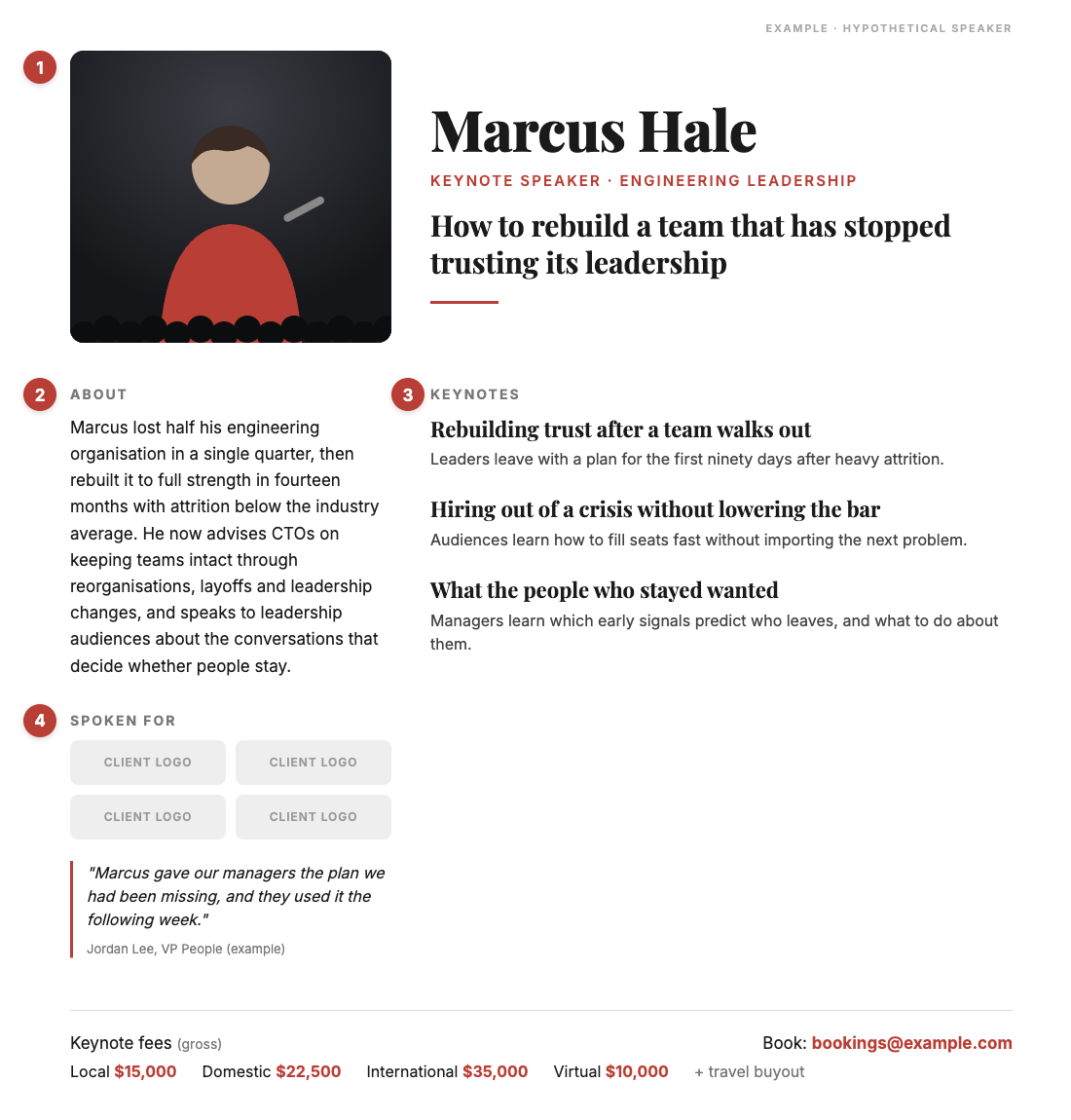
Take a hypothetical speaker, Marcus, who rebuilt the engineering organisation at a logistics company after it lost half its staff in one quarter. Here is how a planner moves through his one sheet, in order, and what each section has to do in the time it gets.
Seconds 0 to 5: the photo and headline
Marcus on stage, mid-sentence, an audience visible behind the lights. The headline reads: “How to rebuild a team that has stopped trusting its leadership.” The planner now knows the subject and that he has stood in front of real rooms.
Seconds 5 to 20: the bio
Seventy-five words. It opens with the number: lost 50% of engineers in one quarter, rebuilt to full strength in fourteen months with attrition below the industry average. Everything after that is support.
Seconds 20 to 35: the talks
Three titles, each with one sentence on what the audience leaves able to do. The planner is matching these against the brief they were given, so the takeaway matters more than the title.
Seconds 35 to 40: proof and contact
Four client logos and one testimonial from a named person, with a direct email beneath them. At this point the planner either forwards it or does not.
Notice what is not on the page. His full career history is absent, and so is any description of his speaking style. Neither would change the decision, so neither earns the space.
How to show your fee
A planner reading your one sheet is checking whether you fit a budget line they already have. Give them enough to answer that in a few seconds: a fee for each kind of engagement and a line on how travel is paid, each labelled gross or net. Leave either out and the next step is an email asking about it.
Anchor the fees to where you book. These are the bands we see across corporate bookings in 2026:
For how each band is built, see our guide to keynote speaker prices.
Fees by location
A single range hides the fact that the same keynote costs you very different amounts of time depending on where it is. A local talk takes half a day, while a fly-in usually takes two days with the flight and an international trip can take four or more. Price each one separately.
Across the speakers on our roster who publish a standard fee for every format, a domestic fly-in averages about 1.5 times the local fee, an international engagement about 2.2 times (the range runs from roughly 1.9 to 3.3), and a virtual session about 70% of the local fee. Here is what that looks like for Marcus, whose local fee is $15,000:
Those four figures sit along the foot of his one sheet, one per engagement, rather than as a single span of $15,000 to $35,000. A span leaves a planner in another city guessing which end applies to them. If a planner sees $50,000 next to proof that supports $15,000, he drops off the shortlist before anyone asks why.
How travel gets paid
Fees on a one sheet almost never include travel, so say how it is handled. There are three common arrangements, and the one you prefer belongs on the page:
A travel buyout is the arrangement planners find easiest to approve, because it turns an open-ended expense into one fixed number. Two recent examples from our proposals: a $1,500 buyout covering economy flights, per diem and ground transport, with the hotel supplied from the client’s room block, and a flat $3,750 buyout covering travel plus up to two nights at a four- or five-star hotel. Travel budgets on our booked events have run from $1,500 to $8,000, with international trips at the top.
Price buyouts by distance the same way you price the fee. A local talk usually needs none, a domestic fly-in typically sits in the low thousands, and international buyouts are quoted per trip. On the page, one line does it: “Plus travel buyout: $2,500 domestic, international quoted per trip.”
Gross or net: label every fee
A gross fee is what the client pays. A net fee is what you receive after a bureau takes its commission. The same speaker can correctly be described as costing $25,000 and earning $20,000, so an unlabeled number is ambiguous to anyone who works with bureaus.
Which number goes on which copy
The copy you send to clients shows the gross fee, because that is what they will pay. If a bureau also represents you, it must match the gross fee the bureau quotes. A client who finds two prices for the same speaker starts to doubt both.
The copy you send to a bureau shows your net fee, labelled “net.” The bureau adds its commission on top to set the price it quotes. Send a bureau an unlabeled gross figure and it will either mark it up again, pricing you out of the room, or assume you expect that number in hand and cut its own margin.
Commission is normally taken on the speaking fee, not on travel, so a buyout passes through at the same figure on both copies.
The small print that saves an email
- State that the fees are for a keynote. A workshop or a second session the same day is priced separately.
- Leave discounts off the page. A nonprofit or education rate is a conversation, and a printed discount becomes the price everyone asks for.
- “Please inquire” on a one sheet you send yourself puts back the round of email the page exists to remove.
Raise your fees when the market tells you to. If you are turning down dates, or booking at your listed fee without pushback, it is too low. Change the page before you quote the new figure, so the paper and the price agree.
How to lay it out
The layout that works most often is a two-column page with the photo and headline across the top. Bio and proof run down the narrow column with the talks beside them in the wide one. Contact details sit at the foot, so they are the last thing seen.
Keep the type large enough to read at a glance on a laptop, because that is where it will be read. A one sheet designed for print and viewed at 60% zoom in an email preview loses most of what made it look good.
Resist the urge to fill white space. A one sheet with room around each section reads as confident. One packed edge to edge reads as though the speaker is compensating for something.
When to update it
Every time you add a stage worth naming or a client a planner would recognise. A one sheet with last year's logos quietly signals that last year was the busiest you have been, which is rarely the impression anyone intends.
Common questions about speaker one sheets
What is a speaker one sheet?
A single page summarising what you speak about and the proof behind it, designed so an event planner can forward it internally without explaining you.
Should a one sheet include my speaking fee?
Yes. List a fee for each kind of engagement (local, domestic, international and virtual) plus a line on travel, and label the figures gross or net. It filters out events that were never going to close and saves two rounds of email.
Should my one sheet show gross or net fees?
Gross on the copy clients see, because that is what they pay. Net on the copy you send to a bureau, clearly labelled, so the bureau can add its commission on top without guessing.
What is a travel buyout for a speaker?
A flat amount added to the speaking fee in place of reimbursing travel receipts. The speaker books their own travel, and the client knows the full cost up front. Domestic buyouts commonly run $1,500 to $4,000.
What fee should a new speaker put on a one sheet?
Most first-time speakers with real credentials book at $5,000 to $15,000. Price to the bookings you can point to rather than to what peers charge, and move the range up once you are turning down dates.
Does a one sheet need to be one page?
Yes. The format is the point. A two-page one sheet is a media kit, which is a different document with a different job.
What file format should a speaker one sheet be?
PDF. It renders the same everywhere and survives being forwarded through three inboxes, which is exactly what will happen to it.